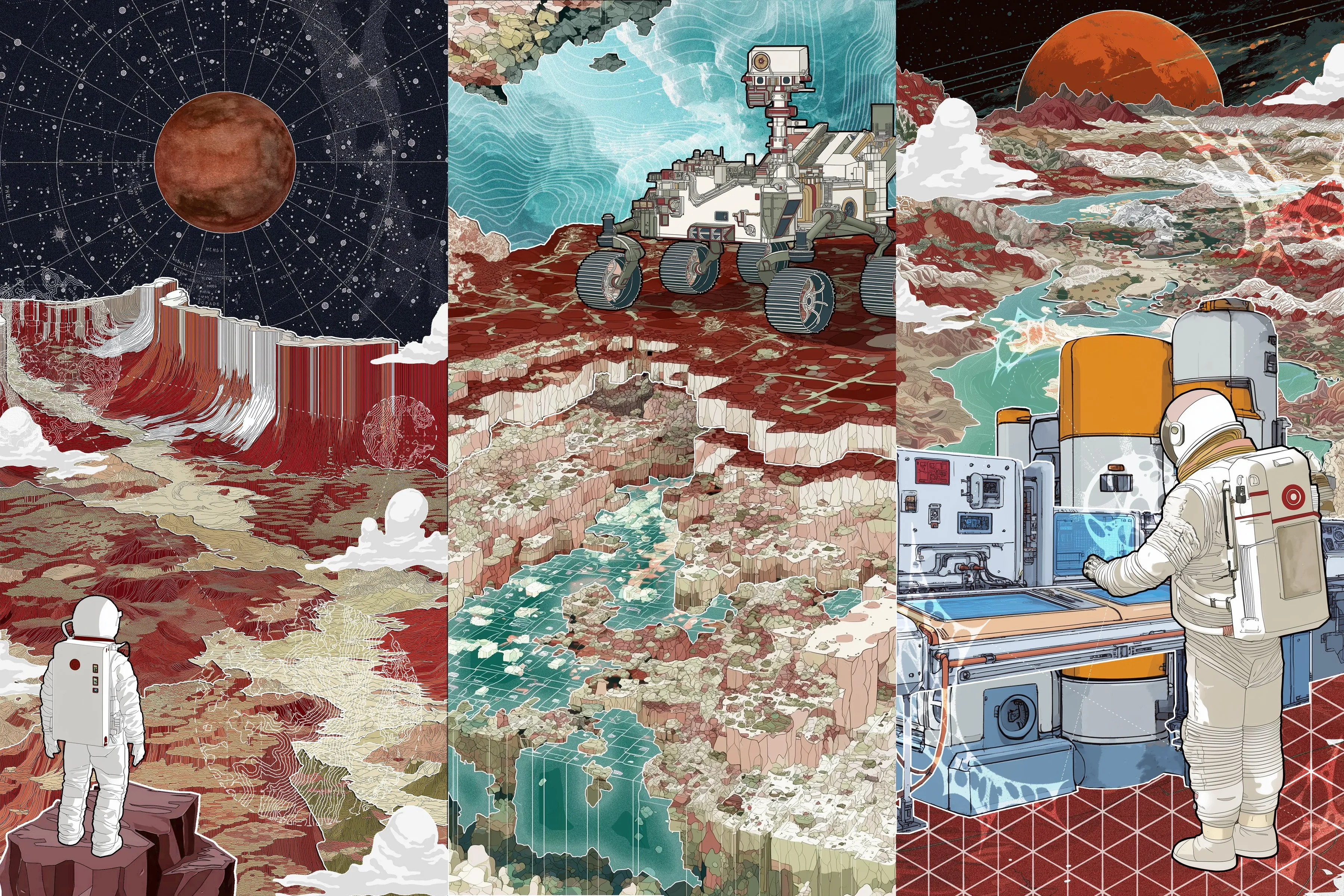
Space is the Place
- Context
- M.Arch thesis, Studio Federico, NUS
- Built with
- Unreal Engine 5, Blender, Rhino, Grasshopper
- Site
- West of Elysium Mons, Mars
- Physical
- 3D printing, laser cutting, hand painting
- Recognition
- Nominated for AkiVAL'26
Space is the Place asks what role architecture plays in an extraterrestrial era. It treats Mars as a site where the desire to expand outwards meets the growing need for planetary survival. Once people live beyond Earth, architecture will do more than shelter life: it will have to create life-supporting ecosystems and build societies from first principles in a hostile environment.
The story is set in 2038, when the United States and China can both land crews on Mars and the race is for resources. Water ice matters most, for life and for fuel. Eight sites were weighed for terrain, subsurface ice, climate, sub-zero temperatures and landing safety, which left one: the plains west of Elysium Mons.
The station is printed from that ice. Modified Mars rovers dig out subsurface ice and print an outer shell with a steel wireframe inside it; inflated polyethylene membranes form the rooms, with steel platforms set within them. It is built in six parts, so the crew can take it apart and move on to the next site to explore, extract and experiment.
Along the way, a simulation in Unreal Engine 5 helped visualise the Martian terrain and conditions such as temperature, sunlight and resource distribution. The form itself was generated, measured and compared over three iterations, then combined into the station.